Wednesday, December 16, 2009

Let the Science Begin


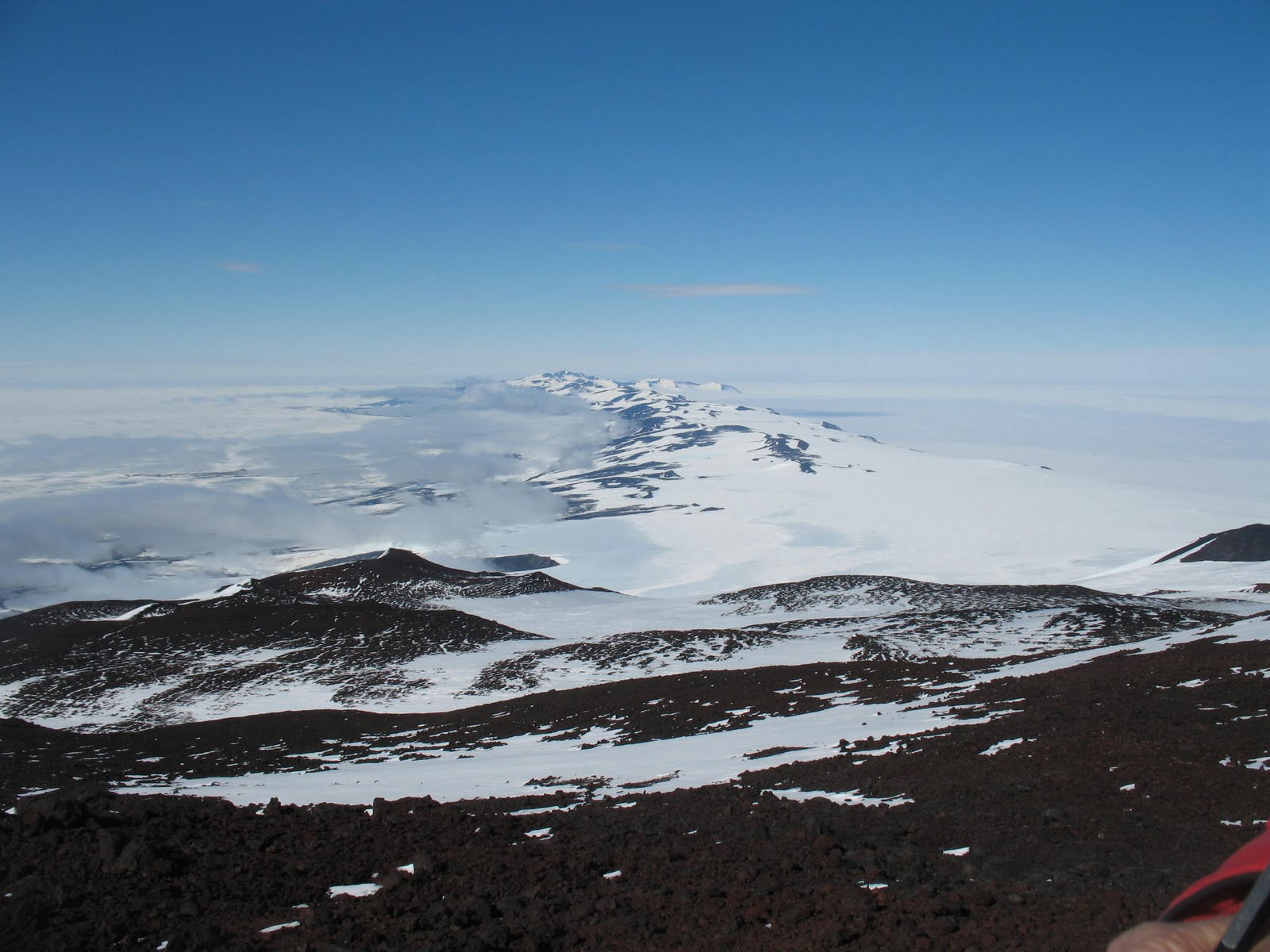
Sunday dawned warm and sunny; the clouds disappeared during the night, and the mountain tents got hot – probably in the 70’s, enough that I opened the door while dressing. Visibility is excellent; we can clearly see Minna Bluff to the South (above), and the Antarctic Coastline to the East (below), stretching away to the South (if these directions seem strange, remember that we’re about 15 miles out to sea, sitting on the ice shelf), and, with the direct sunlight, there is way more contrast than yesterday.


Breakfast was Muesli with milk, plus hot tea. We did a last few housekeeping functions – unpacking the solar chargers for the VHF radio(like you see used in war movies) and the Iridium (satellite) phone. Then, it was time to get started on science – unpacking and assembling the station ‘tower’, a 6 ‘ high metal-pipe assembly that will hold 4 solar panels, a wind turbine, and 3 GPS and 1 Iridium antennae. It should be robust enough to do this throughout the Antarctic winter.

The four tower legs sit on foot-square pieces of plywood, anchored via good sized wood screws. These go in easier with a power drill, so we needed to charge its batteries. Which meant setting up a generator. Which required opening one of the 5-gallon Jerry cans of “Mogas.” Unfortunately, someone did an extremely good job of tightening their caps; they defeated the best efforts of our hands, plus two improvised strap wrenches, one using Martha’s belt. Finally, we were able to open one can; this should be enough to hold us until Monday.

Lunch was gardenburgers with provolone cheese (the Swiss cheese preferred by some residents is still frozen) on bagels, plus curried lentil soup (from a package). The soup was OK (Martha and Thorsten would call it good), but the gardenburgers are great.

We used the Iridium phone for our 1 pm daily check-in with MacOpps. It is quick and easy, but the VHF radio might be cooler – we need to find time to set it up.

After lunch, the station tower came together, with its complement of equipment. It seems ricketier than it did back in Berkeley, but most of the strength should come from the guy ropes.

A word about snow, since we heard a variety of predictions. The snow here is quite fluffy, with a bit of a crust. Usually, boot sink in 4-6 inches. However, sometimes the crust holds, and you don’t sink in. This does not make walking easy. So, generally, putting the "deadman" anchors in was fairly easy. However, we have compacted the snow around the tower (by trampling on it), and so the digging is a bit harder. We also want these to be deeper –18 inches to 2 feet. So, they take some time.

Also after lunch, I called Ruth (my wife). The first try was one-way only; the 2nd worked well. For a guy who doesn’t even own a cell phone, it was strange standing on the ice in the middle of nowhere, talking to someone 2 continents away. They are celebrating Channukah. I brought a menorah and candles, and will celebrate once we’re a bit better established. Being away from my family is definitely the worst thing about this trip.

In the afternoon, we continued with the station setup. By dinner (rice and bean burritos, with cheese, green chili and salsa), most of the station was set up, but not yet connected:


We also worked on assembling the five dipole antennae. These are essentially TV antennae, with "some assembly required." Assembly is a bit painful. They have many screws, and not every box has everything that we need. There is considerable play in some of the joints, so there will be some antenna-to-antenna variation.

It's a good start.

We make it to Moore's Bay

Saturday, 9 am. The weather doesn’t look too promising, with a good layer of high clouds, but the pilot is game to try again, so we reboard our Bell 212, facing the now-familiar luggage wall. The 50 minute flight is relatively uneventful, and the site is free of fog or low clouds. But, with the high clouds, the light is very diffuse, and, from 3000 feet up, there is no surface definition – there are no visible features on the ground, so the pilot can’t tell how high we are; this makes landing difficult. We fly around a bit, chasing a patch of sunlight that is an indeterminate distance from the desired landing zone. After 5 miles, it doesn’t look much closer, and we don’t want to go too much farther, so we turn around, and descend to 2500 feet. Now, the pilot and helo tech in front can begin to make out ground features, so we continue down, past 300 feet when the ground approach warning blares. In the back, we passengers can see features in the ice, but can’t tell how high we are. I was quite surprised when the pilot said that we had landed – it was a very soft touchdown, and, from the side windows, we still appeared airborne.

Once down, Brian hopped out with his avalanche pole, and quickly checked the area for crevasses. He found none, and we unloaded our gear – most of our priority one stuff. Martha checked in with MacOpps on the satellite phone – contact is required before the helicopter can leave.

The remainder of our gear – including our two large tents - was scheduled for a 3:30 supply flight, along with our science cargo. We would certainly survive without this gear, but wouldn’t be particularly comfortable. And, we would have relatively little to do.

We began setting up the tents we had – two “Mountain Tents” for Martha and I, plus a ‘Kiva” for our toilet tent. Until the 2nd load arrives, the Kiva will serve as our cooking tent. Brian sets out to check a 1 km line; we walk out along this line, and test transmission/reception over significant surface distances – 300 m and 1 km. Brian pushed a snow anchor into the snow, connected a 50 m climbing rope to it, and walked off, connected by a prussic (a knot around the rope that will hold if he falls), probing the snow every 20-30 feet with a ~ 4 m long aluminum avalanche pole. He is searching for voids that would signal a large crevasse. I follow; my job is to pull out the snow anchor when he reaches the end of the rope, and bring it to him.

He commented that, with the snow this flat, it did not appear that the site was subject to high winds. The “no high winds” contrasted with what we heard from other people, but his logic makes sense. It also meshes nicely with the almost still conditions since we got here – if this persists, the wind generator will not be useful.

By the time we get back, the tents were set up, and Martha and Thorsten have the stove going, and ‘lunch’ is ready – hot water, to which one can add a variety of dried soups, tea, etc. There is no ‘inside’ place, and it feels very ‘outdoorsy.’ After lunch, we’re out of things to do so we sit on our sleep kits and talk.

Around 2:30, we call in on the satellite phone, and learn that the helos are running about 40 minutes late. Brian would really like to get back tonight. Around 4:10, we try to reach the helo on VHF radio, with no result. We call again, and hear that 36J is about 15 minutes out, and we ‘should’ be able to see it. About 10 minutes later, we hear 36J reporting in to McMurdo that he’s 12 minutes out, and make radio contact. A little while later, he reports that he thinks he can see us; the reverse is not yet true. Thorsten is the first to spot him, 3 dots in the sky.


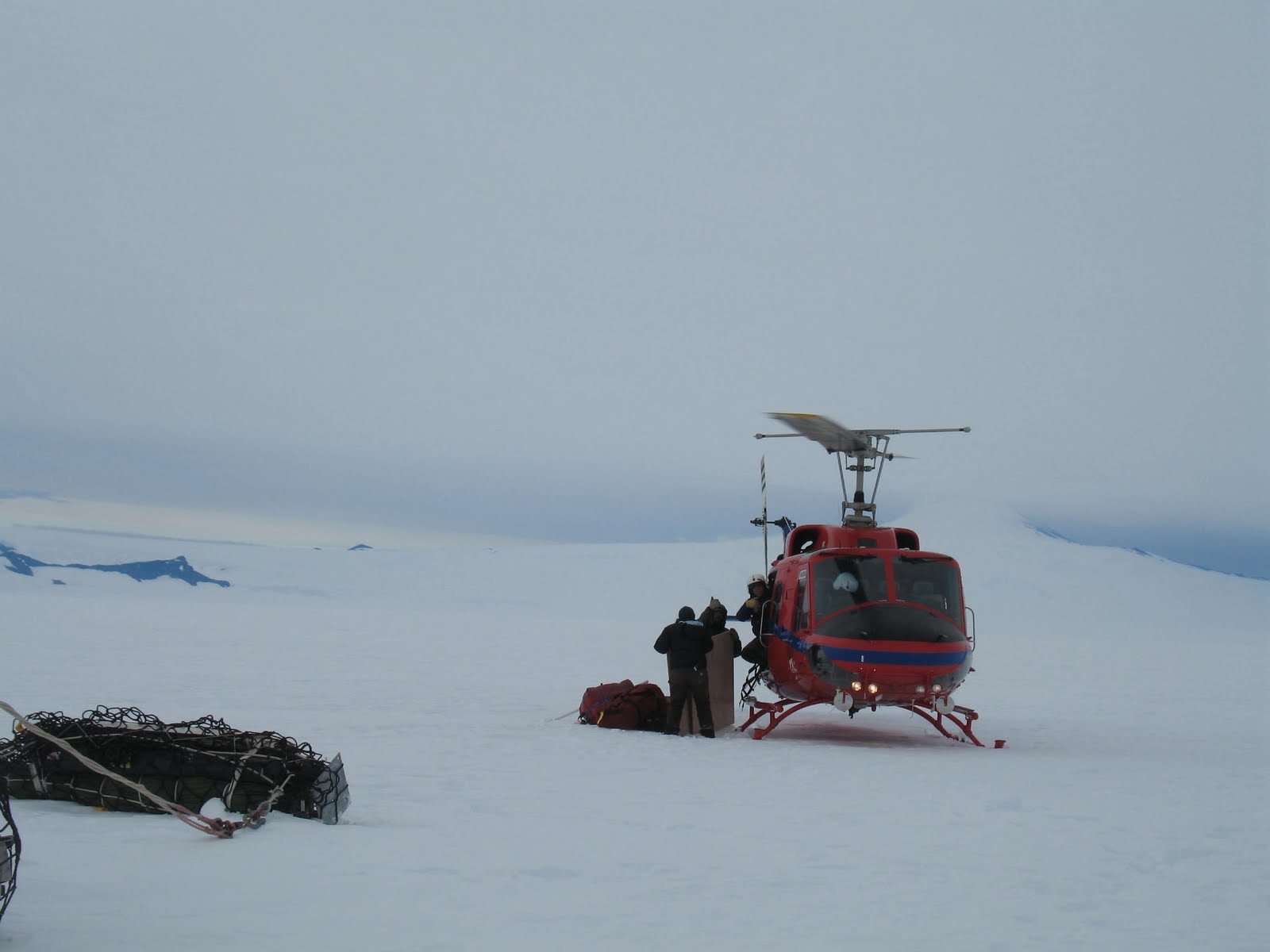
A few minutes later, it’s almost overhead. As he flies overhead, he kicks up a big wind; surprisingly, the wind area is only a few times larger than the radius of the rotor blades. Thorsten and Martha are (as requested), sitting on the supplies to ensure that nothing light gets blown away. He lowers the two sling loads about 10 feet apart, then moves about 50 feet away to land and pick up Brian. We unload 6 4 foot by 4 foot plywood squares – our helicopter-friendly tent floor. Of course, between the loose snow and rotor wash, dragging the plywood is not a ball of fun.
The photo below shows the helo and sling load, and the plywood unloading operation.


A few minutes later, we waved goodbye, and they flew off. It is 5 pm, and we have two tents to set up before dinner and bed. Fortunately, it doesn’t get dark here. The big tent is an “Artic Oven, 10 feet by 20 feet, with a 5 poles on each side, connecting at the top in 3 ‘spiders.’ It goes up easily enough, but then there are the guy ropes to attach. For each rope (or group), we need to dig a 2 foot deep hole, bury a 1 ½ to 3 foot long bamboo stake, wrap a rope around it, tighten it, tie the rope taut,, and then refill the hole with snow. These are called “Deadman” anchors - a fair bit of work. Thorsten’s ‘Scott Tent” also requires setup. While Thorsten and I do this, Martha makes dinner – tricolor tortellini and green beans. Yummy. By this point ( 8 pm), I’m zonked out and go to bed; I believe that the others follow my example pretty quickly.

The top photo shows most of our camp - the largest and finest in Moore's Bay.

All in all, a pretty successful day.

The end of the hiatus

Hi,

It is now Wednesday (Dec. 16) here (one day later than in the States), and the internet is hooked up and working. Camp is set up, station installation and measurements are underway, and we're all happy and healthy. And even warm.
I have been writing blog entries, and will now post them, but it will take a few days to catch up.

Spencer

Friday, December 11, 2009

Mt. Discovery


The one good thing about the Moore's Bay 'boomerang' was that it let me come along on the recce expedition to look for a site for the internet repeater. We got back to the heliport around 1:30, just in time to be on time for the 2:10 flight to Mt. Discovery. Lunch was two small packages of pretzels - nothing but the best for us.

This time, we went in an AS350 "Astar" Eurocopter. This is a smaller, single engine copter that seats 5(?), including the pilot, in a single cabin. This time, I got to sit up front; there are windows all around, and it definitely felt 'airy.' There was even a window right by my foot:


The switch by my toe controlled the intercom.

We flew for about 30 minutes, following our earlier route (we had passed Mt. Discovery going to/from Moore's Bay.

The top picture shows 8796 foot high Mt. Discovery, taken partway up the side. The photo below, taken looking in the other direction, shows Minna Bluff:


McMurdo station is off the the left, while Moore's Bay is to the right. We were looking for a site with good line-of-sight in both directions. We quickly spotted several possible sites. The first possible site was on top of this rocky point:


To me, it didn't look big enough to land a helicopter on. Pablo (our pilot) made a pass, then decided that, although he could land there now, this feat would not be repeatable if the wind were higher. So, we moved higher up the mountain, and found a larger flat area for a helicopter, with several reasonable points to put a repeater on:


Bill and I got out, and, although intervening clouds prevented us seeing McMurdo, he was able to contact them with a line-of-site VHF repeater. At the same time, we had a view of Moore's Bay. It was quite a bit colder than in McMurdo, and it was surprised how quickly I got out of breath walking around. Still, I was astonished when Bill told me that we were at an altitude of over 5,000 feet. I really hadn't felt us climbing. And, going back, we didn't seem to lose altitude.

A good site found, there was no need for plan B, an alternate possibility on Minna Bluff. The photo below, from our return flight, shows Hut Point, with McMurdo station in the middle, between the two peaks:


And finally, a view of McMurdo, as we came in to land:

We're scheduled to try again for Moore's Bay tomorrow at 9:00 am, so I'll sign off now.

Thursday, December 10, 2009

To Moore's Bay .... and back


We arose Friday to reasonably promising weather, and an 11:40 departure. The photo above shows us heading to the helicopter. The helicopter was a Bell 212, with the pilot and helo tech sitting in front, and the four passengers squeezed in back, along with our priority 1 luggage (e.g. food, extra ECW gear, etc.), where additional passengers would otherwise go. We took off, heading South, across the Ross Ice Shelf. Even though the windows were not designed with sightseeing in mind, the view was spectacular:


It was amazing to see so many different forms of snow and ice, complementing the black, stony mountains:


It was also interesting to see places where the snow/ice had clearly melted and refroze (the blue areas in the panoramic photo above). We also flew over Pegasis airfield.


Unfortunately, after we cleared Minna Bluff, we saw that Moore's Bay was covered in low clouds. We couldn't land, so had to turn around and head back to McMurdo.

Unfortunately, these photos don't do justice to the views (although you can click on them to blow them up).

The plan is to try again tomorrow, weather permitting. I'm not so optimistic; a low pressure front has been anchored around here for a while, creating the slightly unusual weather.

Wednesday, December 9, 2009

Interlude

We will not have internet access for the first few days in camp; if we go tomorrow (i.e. the weather cooperates), it will be a few days before my next post. It is also possible that we will never get internet, in which case it will be longer.

Why are we doing this?


Since I have a few quiet moments now, I thought it would be a good idea to explain what we are trying to do with ARIANNA.

In the 19th century, scientists observed that the earths surface was permeated with a mysterious radiation which did things like discharge electrometers and cause certain materials (scintillators) to occasionally give off flashes of light. Noone knew where this radiation came from, but the prevailing assumption was that it came from the Earth. To test this, in 1911-1913, physicist Victor Hess made a series of balloon flights, eventually reaching 5300 m (about 17,000 feet). To his surprise, he found that the radiation increased as he ascended: the mysterious radiation came from space.

By the 1930's, scientist had learned that the radiation could cause Geiger Counters (simple electronic radiation detectors) to occasionally fire simultaneously, even if they are separated by distances of many miles; these simultaneous hits are called cosmic-ray air showers. We now know that these showers occur when an ultra-high energy cosmic-ray particle (a proton (hydrogen ion) or heavier nucleus, like iron) hits the top of the atmosphere and interacts with an oxygen or nitrogen atom. It converts it's kinetic energy into a large number of particles (remember E=mc^2); showers containing trillions of particles have been observed; This corresponds to an initial energy of about 3*10^20 electron Volts, roughly the energy of a well-hit tennis ball, or a boxers punch. The Auger collaboration has produced a nice animation of a shower being created, here. To put things in perspective, the highest energy cosmic rays have about 40 million times the energy of the protons accelerated at the LHC (and more if the cosmic rays are heavy ions), and it would require an accelerator 40 million times as large as the LHC to accelerate them. With current technology, one would need to build an accelerator around the sun to produce these particles. We would very much like to know where these cosmic accelerators are, and how they work.

However, despite decades of study, we do not know where these particles come from. They are electrically charged, so are bent in interstellar magnetic fields; even when we record their arrival direction, they do not point back to their sources. We don't even know if they are protons or heavier ions. Furthermore, the most energetic cosmic rays lose energy in transit, so the ones that we observe must come from the 'local' universe, within about 75 million parsecs (225 million light years) of Earth. This sounds like a long distance, but, on cosmic scales, it isn't very far.

Because of the bending and limited range, to learn more, we need another probe. Neutrinos are attractive, for several reasons. First, being electrically neutral, they are not deflected in-flight. Second, they interact weakly, so can easily escape from dense sources that would contain other cosmic rays.

The flip side of the weak interactions is a huge detector is needed to observe cosmic neutrinos. IceCube, shown below, now being built at the South Pole will be 1 cubic kilometer (about 0.6 miles on a side) in volume. This should be (but no guarantees) big enough for moderate energy neutrinos (from 10^8 to 10^17 electron volts). At higher energies, we do not expect many neutrinos, and need a larger detector. Probably, a volume of 100 cubic kilometers is required; this requires a new technology. Our goal for this winter/summer is to demonstrate this technology: radio detection of neutrinos.


In 1962, the Soviet-Armenian physicist Gurgan Askaryan pointed out that the particle showers produced by neutrino interactions will contain more electrons (which are negatively charged) than positrons (positively charged). These particles are all moving in a almost the same direction, producing an electrical current; in a dense medium, this current will emit radio waves in a cone. The strength of the radio waves scales as the square of the neutrino energy (the process is coherent, for physics experts), so we expect good signals for neutrinos with energies above about 10^17 electron volts.

A number of groups have worked on detecting neutrinos via the Askaryan effect. Collaborations have looked for neutrino interactions in the moon (using radio telescopes), the Greenland ice cap (looking down from a satellite), at the South Pole, and in underground "Salt Domes." Groups are also looking for acoustic radiation produced by neutrino interactions; the shower deposits energy in the target medium, producing a sound wave. These diverse methods have their plusses and minuses. The big advantage of ARIANNA (shared with the South Pole effort) is that it can detect neutrinos that are less energetic than the other approaches. Also, the ice-water interface below the 650 meter thick Ross Ice Shelf reflects radio waves. Because of this ARIANNA will be able to detect downward going neutrinos.

If our prototype works well, this will give us the basis to propose a larger detector, composed of many stations, which would be big enough to detect a good sample (maybe 100 events) of cosmic neutrinos, thereby solving at least some of the mysteries of ultra-high energy cosmic rays.