Thursday, October 15, 2026

Francis Halzen was awarded the 2026 Nobel Prize in Physics, for IceCube!

 IceCube PI Francis Halzen, professor of physics at the University of Wisconsin, Madison has been awarded the 2026 Nobel Prize in Physics, for "“for decisive contributions to the IceCube Neutrino Observatory and the discovery of high-energy neutrinos of astrophysical origin.”  Francis has been a tireless advocate for IceCube, starting in the 1990's, when the idea of a large ice-based neutrino detector was really a laughing matter; few people took it seriously.   This was a simple matter: convince his fellow physicists, numerous committee and funding agencies that the idea was practical, gather one collaboration to produce a proof-of-principle: AMANDA, and a larger one that could be an industrial-scale experiment like IceCube.  Although Francis was not an experimentalist, he was able to bring together a diverse group of scientist, engineers and computer scientists with the necessary skills. IceCube required two key technical development.

The first was drilling deep holes in the ice.  This was most efficiently done using hot water to melt a hole down through the ice, but IceCube required far higher drilling capacity than any previous experiment.  This required a new drill, the development of which often seemed more akin to oil prospecting than astrophysics.   UW Madison and its Physical Sciences Laboratory were responsible for the drilling.  


 The second problem was a data readout that would preserve the details (time structure and amplitude) of the light pulses.  Most of this problem fell to Lawrence Berkeley National Laboratory.   The solution was to put the analog and digitizing electronics in the ice, attached to the photo-multiplier tubes, and send slow digital data to the surface.  The challenges here involved reliability (since the modules would be inaccessible after deployment), low-power operation, and a very wide temperature range, down to -55 degrees C.  In essence, we needed to build 5,160 satellites, but with a fraction of the budget that NASA had.  The required tradeoffs made for many interesting discussions, but the result was outstanding; over 98% of the optical modules are still working, with many having spent 20 years in the ice. 

 The final (and perhaps largest) challenge was funding.  Even after construction was approved, there were many people who were skeptical of (a) whether the IceCube detector would work, or (b) whether we would see anything.  Francis deserves enormous credit for convincing the NSF to fund IceCube, and the NSF deserves enormous credit for listening and taking what must surely have been seen as a risk.  We are all better off for it. 


Tuesday, June 30, 2026

3I/ATLAS - not just the fastest object in our solar system, but the oldest

I've previously written about 3I/ATLAS, a visitor from outside that arrived in our solar system last year - here and here.  Although it is gone now - from the inner solar system (it is now beyond Jupiter, and getting farther every day) and - mostly - from our consciousness, but new information is still coming out. 

A new study finds that 3I/ATLAS may be 10 to 12 billion years old.  In comparison, our solar system is only 4.6 billion years old - a relative newcomer. 

The study used infrared measurements from the James Webb Space Telescope (such as the picture above) to measure the ratio of deuterium (heavy hydrogen, containing one neutron and one proton) to regular hydrogen (just one proton).  The researchers found that it was almost 1%  - more than ten times higher than in comets that are confined to our solar system.   It also contained a higher ratio of carbon-12 (6 protons + 6 neutrons) to carbon-13 (6 protons + 7 neutrons) than is typically found in objects in our solar system. This is evidence that it formed in a 'metal-poor' environment.  n. b.  Astronomers define any object heavier than helium to be a 'metal.'  They also concluded that 3I/ATLAS formed at very low temperatures, less than 30 Kelvin (-405 Fahrenheit).

The measured carbon ratio is consistent with formation in the early universe, when there were less heavy elements around than there are today, while the high level of deuterium points to formation in a cold environment.  Both of these connections are not trivial, relying on more complex comparisons; for more details, please read the paper, which is open access. 

Thursday, March 26, 2026

What do subatomic particles look like?


"What do subatomic particles look like?" sounds like a pretty basic question.  But, in fact, it is not.  Many physicists would considered it ill-posed, since 'look' presupposes observation with visible light, something that is impossible, since, by any measure, these particles are far smaller than the wavelength of light.  Instead, observing subatomic particles requires far more energetic probes.  And, quantum fluctuations mean that they are ever-changing; instead of an instantaneous shape, we can only hope to observe, at best, the average shape, plus some measure of the fluctuations.   Like many larger objects, the way that they look depends on how one looks at them.

Consider the proton, the central nucleus of a hydrogen atom.   When we ask what it looks like, we can expect to learn about its size and hopefully shape.  Is it spherical?  How does its density change in going from the center to its periphery?   This begets an important question: density of what?  There are many different ways to characterize a proton.  One could measure the charge distribution, mass density, or at internal pressure, or look at where the quarks and/or gluons are within it.  One could also probe quarks or gluons within a specific momentum (Bjorken-x) range. 

Or, one could ask where its 'protonness' is.  More generally, one can ask where its baryon number is.  Baryon number is what makes protons and neutrons what they are, and distinguishes them from mesons.  In the valence quark model, protons have three quarks (as in the left drawing above). When one adds in gluons and evanescent quark-antiquark pairs, it looks more like the drawing on the right.  Then one can define baryons as having three more quarks than antiquarks.  But, this is not the only possibility.  However, sophisticated mathematics - the requirement of local gauge invariance of the proton  - points toward the existence of a baryon junction, comprising a nonperturbative localized configuration of gluons which is connected to these three quarks.  This model makes some predictions that seem to be borne out experimentally.   Another consequence is that the protonness is likely to be concentrated in the center of the nucleus.

We can probe this using a reaction that is sensitive to baryon number.  Backward photoproduction (also known as u-channel photoproduction) is one such reaction.  In it, a photon interacts with a proton, producing a meson, plus the original baryon.  Normally, as in diagram (a) above, the produced meson carries most of the momentum of the photon; the momentum transfer from the proton target is small.  But, sometimes, the proton acquires most of the photon momentum, leaving the meson nearly at rest.  This can happen if there is a large momentum transfer from the proton (diagram (c)) or if there is a small momentum transfer, but transfer also exchanges baryon number (diagram (b)).   Either way, the photon is rather directly probing the baryon number in the target.  

We use this reaction to 'image' the proton by looking at the momentum transfer in these backward production reactions.   The higher the momentum transfer, the smaller the object that is struck.  In more technical terms,  a two-dimensional Fourier transform of the transverse momentum of the outgoing meson gives us a density distribution of  baryon number within the proton.  In a preprint (arXiv:2603.03730) we (me, plus colleagues from U Washington, Livermore and UC Davis) did this for a number of different backward production reactions, along with, as a benchmark, some otherwise-matching conventional forward photoproduction reactions.  The plot below shows our results:

And there you have it - pictures of the essence of the proton - the seat of its baryon number. Here, the x axis is the radius (distance from the center of mass of the proton), in fermi; 1 fermi is 10-15 m.   The y axis is the baryon number density.   For simplicity, we characterized these distributions by their average (rms) radius.  We found that the average transverse (after squashing the proton down to two dimensions) radius of the baryon number was 0.33 to 0.53 fm.  In comparison, a number of other measures of the proton size, based on its charge density, or parton densities, all found larger radii, at least 0.67 fm.  So, a protons protonness is concentrated near the center of the proton.  

There are caveats on this result.  If you are interested, please read the paper (click on the PDF link on the web page above), but overall it seems fairly (pardon the pun) solid.


Monday, November 24, 2025

3I/alpha re-emerges from behind the Sun. But, is it an alien artifact?

 The interstellar object (visitor from another sun) 3I/ATLAS has reemerged into view, after being hidden behind the sun.  It continues to attract considerable attention, from both telescopes and humans.  


 The images above, taken by the James Webb telescope are typical of recent images.  In this and other images, it appears to be a comet, with a small central nucleus, with a large coma (ice/dust cloud) on one side.  This cloud is expected; as a comet approaches the sun, surface ice is melted and ejected, taking some of the comet's rock/dust with it.  The coma is quite visible since the dust and ice is effective at reflecting sunlight.  Most of the other pictures are less detailed; there just wasn't much light to work with, so the images are fuzzy.  

3I/ATLAS has attracted much attention on two fronts.

First, it is only the third extraterrestrial object seen.  It appears different from both  1I/ʻOumuamua, which is a bit of an oddball by both accounts, and 2I/Borisov, which also looks a lot like a comet, but is  considerably smaller than 3I/ATLAS.   But, it looks enough like a comet so that NASA has officially called it one (rather than an asteroid).  In fact, if anything, the surprise is that it looks so much like the garden variety comes from our solar system. 

Second, there has been considerable speculation that it be an artifact produced by an alien civilization.  The reflected light has been postulated to be light emitted by the object.  There were also suggestions that it would alter course and head for Earth, or make other dramatic maneuvers.  However, the acceleration that we see is all consistent with a combination of gravity, plus the expected velocity changes due to the out-gassing mentioned above.

The alien-object hypothesis has some attraction.  It would be very very cool, and would radically change our view of the galaxy.  But, extraordinary claims require extraordinary proof.  That is lacking here.  There is no evidence of active maneuvering.  The observed light looks much like we expect from a comet.  

So, scientists have, very reasonably, fallen back on more mundane studies.  An interstellar visitor is plenty cool, even if it 'just' a comet from another solar system.

Tuesday, October 21, 2025

Antarctica - redux

The  Lawrence Berkeley National Laboratory Engineering Division communications people have put out a nice story about  Thorsten Stezelberger and my work in Antarctica - both ARIANNA and IceCube.  It is available at https://physicalsciences.lbl.gov/2025/10/14/visiting-antarctica-in-service-of-science/

This is somewhat timely, as the 2025/2026 Antarctic season ramps up.  For neutrino astronomy enthusiasts, this is a big one, featuring the deployment of the IceCube Upgrade.   The upgrade will consist of seven additional strings.  The strings will be densely packed (close together), with an energy threshold of a few GeV, giving IceCube a huge boost at low energies.  This should enable us to make a definitive measurement of tau-neutrino appearance through oscillations, and help us pin down the parameters for neutrino oscillation more precisely than previously possible.  The upgrade will also be filled with calibration devices that should allow us to measure the optical characteristics (scattering and absorption)  of the ice far more precisely.  this ice-property data should improve the accuracy of all IceCube measurements, by reducing our systematic uncertainties from ice property uncertainty.  

Monday, August 11, 2025

Alien visitors, redux: Why are we seeing them now?

 After my last post on 3I/ATLAS, an interested reader (full disclosure - my wife, Ruth Ehrenkrantz) asked an interesting question: Why are we only seeing the interstellar visitors now?  We have now seen three in eight years, after centuries of nothing?  

 The answer to this question is: technology.  Finding small (asteroids and comets both qualify) objects in our solar system is a matter of taking multiple photographs of the sky, spaced days or weeks apart, and looking for points of light that are moving against the fixed background of stars.    One needs to look at a lot of images to find a few moving objects.   Finding the even rarer (cf. three in eight years) objects that are moving too fast to originate in the solar system is even harder, and requires fast searches of large regions of the sky.

High-speed searching requires automation, to methodically take photos at appropriate intervals and automatically compare the images.  Correcting for different seeing conditions is not trivial - if the atmosphere is a bit more turbulent or hazy, images will look different.      This is technology that has been developed over the past few decade, driven by "Planetary Defense"which even has its own office at NASA.  Despite a name evocative of "Space 1999," this office is focused on a more prosaic concern, the possibility that an errant asteroid or comet might hit the Earth, ala the Tunguska meteorite or, worse, the asteroid that wiped out the dinosaurs (as shown in the visualization below, from New Scientist magazine). 

One well known search program is Asteroid Terrestrial-impact Last Alert System (ATLAS), which found 3I/ATLAS.  It uses five robotic telescopes, like the one shown above to search around the ecliptic plane (the plane containing the orbits of the planets around the Sun), looking for objects that might come close enough to Earth to pose a danger.  When it finds a moving object, it will follow it to determine its trajectory, and project its movement into the future, to see if it will come close to Earth, or even might hit it.  Of course, the further one projects into the future, the larger the uncertainty.  

Sometime - three times so far - these automated searches will find objects that are moving too fast to be gravitationally bound to the Sun.  It is not at all surprising that our observations of these extra-solar objects has started in the last decade, as searches like ATLAS have ramped up.   

Incidentally, although 3I/ATLAS looks like a typical comet, that has not stopped some astronomers - notably Harvard's Avi Loeb - from speculating that it may be an extra-terrestrial probe, on the basis that it is coming surprisingly close to several planets (not Earth, though).   Other astronomers continue to study it, and nothing too surprising has been observed.  Recently, it has been found to contain water, for example. 


Monday, July 21, 2025

Another alien visitor enters the Solar System

 The Solar System recently welcomed another visitor from another star:  3I/ATLAS.  We don't know much about it yet, but it seems considerably larger than ‘Oumuamua (which I wrote about previously) and 2I/Borisov - maybe 5 kilometers 3 miles) across, although considerably larger diameters - up to 12 km - have also been suggested, based on the hypothesis that it reflects only a small fraction of the incident light.  It is thought to be comet-like, with the outside made up of grains of water ice and silicates.  As the surface is heated by the sun, it is likely to form a coma - a long visible tail of gas and dust released as the ice melts.  Watching this evolution will tell us much about the nature of 3I/ATLAS. 

When it was spotted, it was roughly as far away as Jupiter. It is approaching rapidly and should reach 1.3-1.4 astronomical units (AU) from the Sun (1.3-1.4  times as far away from the Sun as the Earth is) in late November.  Unfortunately its closest approach to the Earth will only be at 1.8 AU.  Worse, when that happens, it will be on the far side of the Sun from us.   Depending on how much it brightens, it should be visible with relatively small telescopes, though.  So far, it appears to have a reddish color, perhaps a sign that it contains methane.   Interestingly, its trajectory is near the ecliptic plane of the Solar System - the plane that contains all of the planets orbits. 

It is also moving fast - faster than ‘Oumuamua -  and will reach 150,000 miles/hour during its closest approach to the Sun.  This simplified the detection, as can be seen from the gif below, combining images taken with the Asteroid Terrestrial-Impact Last Alert System:


 The moving dot shows how 3I/ATLAS stands out from the stationary background stars.  It is coming from the general direction of the center of our galaxy, which is also the direction of the highest density of nearby stars.   It was likely ejected from some other solar system by a close encounter with a planet which left it with a velocity high enough to escape from that sun.  

The three alien visitors that we have discovered are all quite different.  ‘Oumuamua is an oddball, while 2I/Borisov and 3I/ATLAS seem, except for their much higher velocities, comet-like, not too different from  the other comets that we see in the solar system.  More data is needed to draw any conclusions, but it does seem that these interstellar objects are relatively common, with three discovered in 8 years.  

Because of their large velocities and short notice of the arrival times, we probably won't be able to get a sample from one of these objects any time soon.  But, if we are patient, it may be possible to do a fly-by and get some high-resolution photos.  

Sunday, May 4, 2025

Two slit interferometry – the fully quantum edition


Today, I want to write about something a bit different – a unique 2-slit interferometer (aka the double-slit experiment).  In the standard 2-slit interferometer, a beam of photons, electrons, ions or whatever spreads out and passes through two slits.  The beams passing through the two slits recombine, producing an interference pattern.  You might have seen this demonstrated in high school or college, but the basic idea is pretty straightforward.


Some standard elements of this are that the source is a single beam, and then that the beams recombine after passing through the two slits.  Today, I want to discuss a unique version of this experiment that lacks both of these elements.    

This interferometer consists of two relativistic heavy ions that encounter each other at a collider.   One ion can emit a photon, which can then scatter off of the other ion, and emerge as a particle – this can be a rho0, phi , J/psi or other vector meson –particles with the same quantum numbers as the photon.   At low transverse momentum), we cannot tell which nucleus emitted the photon, and which is the target.  Quantum mechanics (QM) tells us that these two possibilities can interfere with each other.  Because vector mesons have negative parity, this interference is destructive, and the production rate goes to zero as the transverse momentum approaches zero.  This suppression was experimentally observed by the STAR Collaboration back in 2009.

One important point is that the two ions come from completely different directions and share no common history, so there is no single source!  Instead, the two sources are synchronized in-phase by the symmetry of the problem. 

Another unique feature is that vector mesons are very short-lived, with the rho0 lifetime about  10-23 seconds, so that, even moving at the speed of light, a rho0 travels about 1 fermi (1 fermi = 10-15 m) before decaying.  This is far less than the minimum ion-ion separation, which is about 15 fermi.   When the rho0 decays, it produces two charged pions (pi+pi-).   Because of the near-immediate decays, the two ions are essentially sources of pion pairs.

So, any interference pattern can only appear much later, when the pi+pi- amplitudes overlap.  However, the p+ and p- go in nearly opposite directions, and are well separated by the time pions from the two sources can overlap.  In short, the only way for this interference to happen is if the amplitudes summing and interference appear long after the rho0  decays, and the system has spread out.   Strange as this sounds, this well explained by quantum mechanics where the wave function collapse occurs when the interference is observed.   The question of when this observation actually occurs is the subject of debate, but one can think of it happening when the pions interact in the detector.  The figure below nicely illustrates these points of the interference.  

 Why am I writing this now?  Four colleagues and I have written a long review paper discussing this interference, which has just been published in Progress inNuclear and Particle Physics (with open access); it is also available here onthe arXiv.  The article also recaps the data that supports the existence of this interference - both the suppression above, and some interesting angular effects.  

Many aspects of this interference may be somewhat counterintuitive.  However,  they are in accord with the ideas of quantum mechanics, and, more importantly, are well supported by data.  So, they are useful descriptions of the way that Nature works.

Enjoy.  

Saturday, April 19, 2025

Neutrinos are lighter

 One of the biggest questions in neutrino physics is: how heavy are they?  We know that there are three types of neutrinos, associated with the electron, muon and tau leptons.  By observing their oscillations, we can observe the mass differences (actually, the square of the mass differences, so we're not sure which is heaviest) between these three types.  However, their actual masses are still unknown.  

Over the past few decades, we have worked to measure their absolute masses, but so far have only determined a succession of ever-more-stringent upper limits.  Most attention is focused on the electron neutrino, because it allows for the most stringent limits.  The technology of choice is the beta decay of tritium - an isotope of hydrogen consisting of one proton and two neutrons.  Tritium decays into helium three, plus an electron and an electron-neutrino, with a half life of 12.3 years.  This is a low-energy decay, releasing about 18,590 electron volts of energy.  For comparison, other, more typical beta decay reactions release ten to thirty times as much energy.  Another point of comparison is an old-fashioned cathode-ray tube in a television receiver, which uses electrons accelerated to up to 25,000 volts - more than from tritium beta decay.

In these beta decay reactions, some of the energy is carried off by the neutrino, with most of the rest going into the electron; the recoiling helium-3 also carries off a bit of energy.   Because beta decay is well understood, we can very accurately predict the distribution of energies carried off by the electron; this predicted spectrum has a small dependence on the neutrino mass;.  The number of events where the electron carries off almost all of the energy decreases as the neutrino mass increases.  We can fit the electron energy spectrum in this endpoint region to determine the neutrino mass. 

The KATRIN collaboration has done this, and just released a new upper limit on the electron-neutrino mass; it is less than 0.45 electron volts, at a 90% confidence level.  For comparison, this is less than one one-millionth of the mass of the electron.  It is about a factor of 2 below previous measurements.  The result is an enormous tour-de-force, since the change in the energy spectrum is tiny.  The collaboration used an enormous spectrometer (pictured above) and studied 36 million electrons, which were already selected for being of particularly high energy.  

Although KATRIN will release results with more data, and, likely, a tighter upper limit, this is near the end of the line for the spectrometric approach that we have used for the past few decades.  A better spectrometer would also have to be a bigger spectrometer, and it is just not possible (economically, and probably technically) to build a much larger instrument.  Instead, we are starting to investigate new approaches that involve trapping electrons in a uniform magnetic field, and observing the synchrotron radiation that they produce, using very sophisticated radio detectors.


Friday, March 14, 2025

The new neutrino heavyweight champion - part 2

 In October (2024), I wrote about the very high energy neutrino event found by the KM3NeT Collaboration, which is building a neutrino telescope in the Mediterranean Sea, of the coast of France.  Details of that event have finally been published in Nature, with enough new info to be worth a second look.   The event seems well reconstructed as a through-going muon, with a muon energy in the detector of about 120_{-60}^+100 PeV.  Assuming that the muon comes from a neutrino (alternatives have been discussed in the literature, but they all involved speculative beyond-standard-model physics), then the neutrino energy will depend on how far from the KM3NeT detector the muon was produced (they lose about half their energy in 1400 m of water), and what fraction of the neutrino energy was transferred to the muon.   This becomes a fairly complex probability calculation, where the most likely energy depends on the assumed neutrino energy spectrum, but the most likely neutrino energy is about 220 PeV, with a 68% confidence level of 110-790 PeV and a 90% range of 72 PeV to 2.6 EeV (see the KM3NeT paper for details).  These are very high energies; 220 PeV is 30,000 times the maximum energy of a proton in CERN's Large Hadron Collider.

The paper also addresses the question of where the neutrino came from; the sky map below shows the best-fit direction along with the uncertainty contours, along with some possible source candidates. To make a long story short, there are some plausible candidates from near (within the error circles), but nothing stands out as a likely candidate.


The paper also addresses the tension between IceCube's non-observation of any similarly energetic neutrino and the KM3NeT event.   The KM3NeT paper refers to 287 days of live time, whereas the complete/almost complete IceCube has been taking data for about 16 years.  And, KM3NeT is only partially complete, so it currently has much less sensitivity than IceCube.  The degree of tension depends on many details of the calculation, but it is somewhere between one and two orders of magnitude, or between 2 and 3 sigma.  This is not that likely, but it is also not that unlikely.   And, given that the event looks solid, we will probably have to live with it.

The plot at the top of this post shows the flux calculated by KM3NeT (in blue) along with a 2018 limit from IceCube and another limit, from the Auger surface air-shower array in Argentina.  The points at lower energies are IceCube data, but at energies above 10 PeV, there are only limits.  It is worth pointing out that IceCube has a new limit - available on the arXiv, not mentioned in the KM3NeT paper, that is a factor of 3-4 lower than our 2018 limit, further increasing the tension between the two experiments.

Saturday, December 28, 2024

Do we live in a special place - Part 2


A closely related question to whether we live in a special (high or low density) place in the universe is whether the universe looks the same in all directions.   In a homogeneous universe, everything should look the same in all directions.   This homogeneity has been the default assumption for many years.  For example, IceCube studies of astrophysical neutrinos assume that the flux is the same from all directions.   


However, data is beginning to challenge this homogeneity.   Moderate energy (1015 eV = 1 PeV to 1017 eV =1 00 PeV) cosmic rays exhibit small density fluctuations at large length scales.   This may be due to the motion of the Earth through the galaxy, so only represent local inhomogeneities.


At higher energies, though, the situation is more interesting.  At energies above 1019 eV, cosmic-ray protons are thought to travel in relatively straight lines, with only limited magnetic deflection in galactic magnetic fields.  So, any observed anisotrophy could be a sign of inhomogeneity at supra-galactic distances.   


The two main experiments studying these ultra-high energy cosmic-rays are the Pierre Auger Observatory (PAO) and the Telescope Array (TA), respectively located in the Southern and Northern hemispheres – Malargue, Argentina and Utah, the United States respectively.  These are large arrays – the Pierre Auger Observatory encompasses 3,000 km2 (1200 mi2), so can detect very rare, very energetic events.   These two experiments have seen long-standing disagreements in both the spectrum and the composition of the highest energy cosmic rays.   Above energies of about 30 EeV (1018 eV = 1 EeV) the Auger experiment sees a significant shift toward a heavier cosmic-ray composition (mostly iron,rather than mostly protons) with increasing energy.  The mass is inferred by observing the development of  the cosmic-ray air showers; iron interacts more strongly, so its showers peak higher in the atmosphere (see picture above, from the TA Collaboration).    In contrast, the TA prefers a composition that is mostly lighter elements; the TA also prefers a higher cosmic-ray flux than the Auger Observatory. 


The tension between the two experiments has been known for some time, and the two collaborations have tried hard to understand the differences. One intriguing possibility that is gaining some traction is that the difference is because they are observing different portions of the sky, and seeing different contributions from different sources.   This is supported by the emerging evidence for directional anisotropihes in the measurements from the two experiments (see some recent Auger data from a combined anisotrophy study below. In retrospect, this is not too surprising, but it does represent a shift in thinking for many astrophysicists.   


Sunday, November 3, 2024

Do we live in a special place (in the universe)?

Up close, the universe is very inhomogeneous.  There is the odd very-dense star or planet, but most of it is mostly empty space - vacuum.   But, as we zoom out, we expect different large chunks of space to be similar.  These chunks must be very large, because we know that matter clusters in solar systems, galaxies, and even galactic clusters.    

If the universe is indeed homogenous, with matter evenly distributed, then one might think that there is no reason to think our local neighborhood is special.  But, there are a couple of reasons to think that this isn't true.  The first is the anthropic principle.   We live in a place that supports human life - on a planet orbiting a star.  That  puts us in a galaxy which is in a galactic supercluster.   There may be isolated stars not in galaxies (ejected from galaxies, or ?), but they are rare, and the odds favor stars in galaxies.  The fact that we are in a galactic supercluster means we are surrounded by more matter than a random point in the universe, at least unless we average over a very large volume.   

This discussion is important for astrophysicists - especially cosmic-ray enthusiasts because not everything we study comes from far away.  Charged-particle cosmic rays (protons or heavier particles) come mostly from our galaxy, with the most energetic ones likely coming from other nearby galaxies.   Gamma-rays also mostly come from our galaxy.    In contrast, neutrinos can come from far more distant sources.  So, if we want to compare the neutrino rate with the extremely high-energy (i. e. extragalactic) cosmic-ray rate, we have to account for the fact that the cosmic-rays come from a higher-density region of space (i. e. our relatively local neighborhood) than the neutrinos, which come from a much larger volume.   

That said, it is not easy to quantify the increase in density,  since our measurement methods necessarily vary with distance.  A 2009 paper, Andrea Silvestri and Steve Barwick (both at UC Irvine) looked at this effect.  The published version, in Phys. Rev. D is available here, while the freely available arXiv version is available here. Silvestri and Barwick argued that, for rare neutrino sources (if they are rare, then they are well separated, and likely far from us), more than 5 Mpc (megaparsecs) away, there is no anthropic increase in density, but, at smaller distances, the density increase is significant, about 5.3.  Other groups have had different somewhat different estimates;  As our neutrino measurements become more precise, it will be necessary to investigate this bias in more detail.

In my next post, I will discuss a closely related question: does the universe look the same in all directions?

Tuesday, October 8, 2024

The most energetic neutrino


Although IceCube is still the largest neutrino telescope around, it is not the only game in town.   The KM3NeT ARCA telescope is now large enough to study astrophysical neutrinos.  ARCA is located in the Mediterranean, of the coast of Nice, France.  It uses seawater as its optical medium, instead of ice; this has plusses and minuses.  

At the Neutrino 2024 conference in Milan, Joao Coelho (from APC - Paris) presented some initial KM3NeT results.  They have observed an enormously energetic event - far more energetic than any neutrino that IceCube has seen.  The event - seen above -  lit up a fair portion of their detector.  Although the collaboration is still working on a paper on the event - and so has been rather tight-lipped about the details, Joao did talk about some early work estimating its energy.  The Collaboration estimated the energy by comparing the observed event with simulated events of different energies.  

The plot below compares the number of hit photomultiplier tubes (PMTs) for the event with several simulations.  It is important to remember that the scale here is not linear; there are only a certain number of PMTs in the detector.  The deposited energy appears considerably higher 10 PeV - probably 20-40 PeV if one ignores the non-linearity, and higher with it.  This is for the muon energy; the neutrino energy will be higher to much higher, depending on how far away the neutrino interaction is from the active volume and how much energy the departing muon carried off.

The event appears to come from slightly below the horizon.  The collaboration has not discussed possible backgrounds.  The only obvious background in this energy range would be a very energetic muon bundle from a cosmic-ray air shower.   However, this would require a significant misreconstruction - large enough to seem unlikely. If one looks carefully (see the top figure), one can see evidence of stochastic (non-uniform) energy loss, as expected from high-energy muons.  

 Without knowing the energy better, it is hard to tell how compatible this event is with the IceCube limits on extremely-high energy (EHE) neutrinos, but there is at least some statistical tension.    Still, this observation is great news for all high-energy neutrino enthusiasts.

Monday, May 13, 2024

The rock from another world: ʻOumuamua


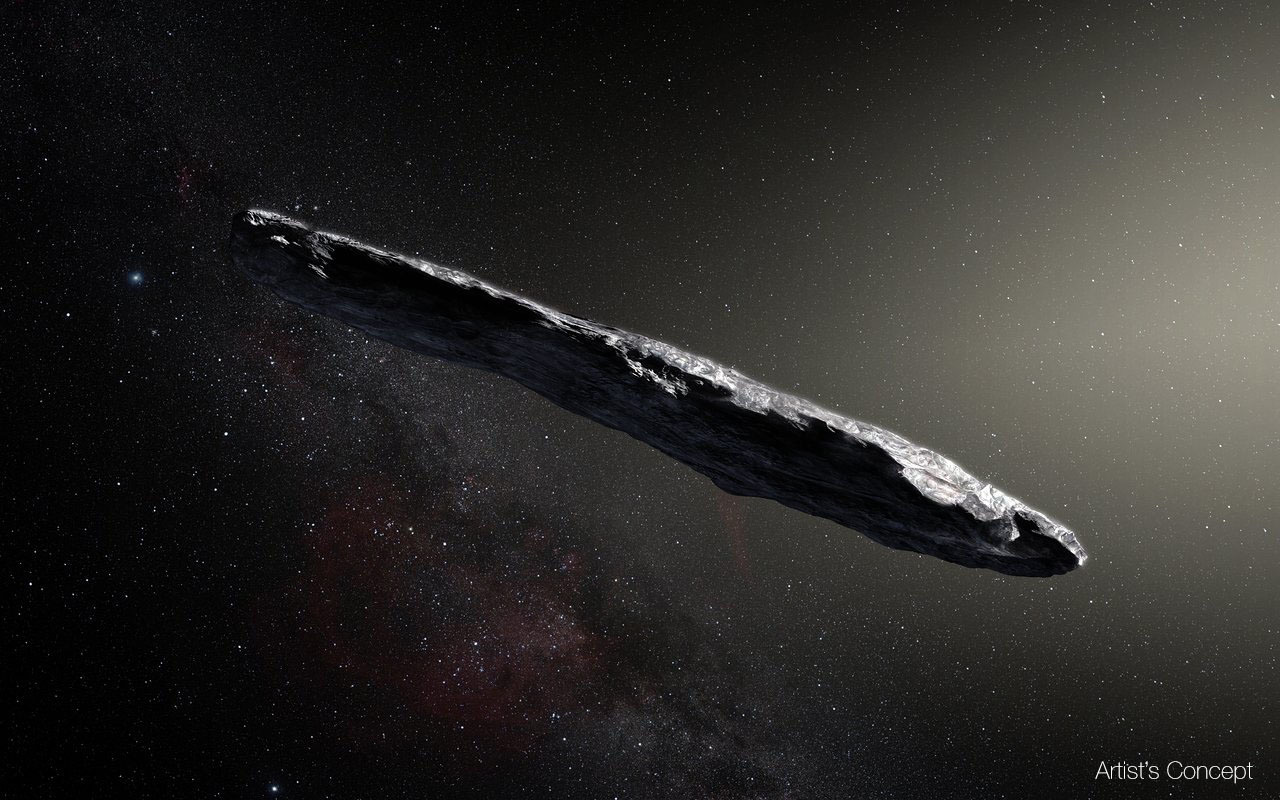
Oumuamua - NASA Science

 SETI - the search for extra-terrestrial intelligence and exobiology - the search for extra-terrestrial life are two of the most interesting scientific endeavors of our generation.  The odds of finding extra-terrestrial life may be low, but, increasingly, they seem not that low.   As we learn more about the universe, the likelihood of finding planets with conditions that could harbor life seems higher and higher.  Over the past 20 years, we have learned that planets around other solar systems are common, and that, probably, there are planets in the 'habitable zone,' where liquid water can exist.

One recent event has further stirred interest.  A large rock - named 'Oumuamua,  Hawaiian for scout - flew by the Earth in 2017.  It attracted enormous attention, for several reasons.  First, it was moving very fast - too fast to be in orbit around the Sun.  So, it most likely came from outside the solar system, making it the first interstellar object that we have studied.  Second, it was exhibiting signs of acceleration, although some scientists attributed this to natural outgassing as the object was warmed by the Sun. 

Second, as the picture above (a NASA artists conception, based on optical and radar imaging) it was long and thin, measuring between 300 and 3,000 feet long, with a width and thickness between 115 and 550 feet.  This is not as expected for natural bodies.  The large objects (planets and planetoids) that we can see are fairly round, and, while smaller objects like asteroids and the solid parts of comets are fairly irregular, they are not that irregular.     

 All this led to speculation that 'Oumuamua might be an alien spacecraft visiting our solar system.  There are reasons to wonder - although a gravitational slingshot acceleration in another solar system could possibly explain the acceleration, the probability of an object from another solar system randomly coming so close to Earth (85 times the distance to the Moon) is very very low, unless these objects are very common.  but, it seems hard to explain how they could be naturally accelerated to such high energies, so it seems unlikely that they are common.

These observations of course spurred searches for similar objects.  One interesting search started by looking for similar high-velocity objects that might have been spotted by early-warning radars.  One such trace from 2014 appeared to show a high velocity object, consistent with a diameter around 1.5 m hitting the Earth, near Papua New Guinea.  Harvard astronomer Avi Loeb assembled a team to search for debris from that meteorite.  The team has presented evidence of tiny metallic spherules with 'a chemical composition of unknown origin.'   This has been hotly debated, and other groups have claimed that the spherules are from coal ash.   The debate continues, but, extra-ordinary claims require extra-ordinary proof, so it is, at-best, premature to bet on the extra-terrestrial origin.  

But, the unusual characteristics of 'Oumuamua are well supported by multiple observations, and are well accepted in the scientific community.  Clearly something very interesting passed by, and we as a community should be thinking broadly about follow-up studies.


Thursday, January 25, 2024

Citizen Scientists - and neutrinos


Citizen-scientists have a long history; amateur astronomers have made many important discoveries, and, although opinions are mixed  amateur archaeologists have brought many important sites to the attention of professionals.  Now, citizen-science is moving into a new area: neutrino astrophysics.

Although neutrino telescopes are far beyond the reach of amateur scientists, their data is not.  IceCube has enlisted the help of interested amateurs to help with a difficult pattern-recognition problem: classifying the types of neutrino interactions that IceCube sees.  The figure above lists the different types classifications that are currently being considered.   Distinguishing these classes of events is difficult for computer algorithms, but generally easier for people. 

The program, called "Name that Neutrino" is hosted on Zooniverse, a web platform designed for citizen-science applications.  A recent paper, "Citizen Science for IceCube: Name that Neutrino," discusses the program, and reports on the results of classifications by more than 1,800 volunteers.  

All-in-all, a great way to teach science enthusiasts about IceCube and neutrino astronomy.

Wednesday, December 20, 2023

The mystery of the most energetic cosmic rays deepens

 Recently, the Telescope Array (TA) Collaboration reported on the observation of a cosmic ray with enormous energy: 244 exa-electron volts (EeV, 2.44*1020 eV), or roughly 40 Joules.  This is one of a handful of events seen in this energy range - with an energy roughly comparable to a well hit tennis ball.   Although this is not the most energetic particle ever seen, it is pretty close.  

Fig. 1. A skymap, showing the best-estimate directions for the event, after correcting for expected deflection in galactic and extra-galactic magnetic fields.   The labelled circles are the best estimates for different assumptions about nuclear composition, from protons (p) through iron (Fe) for two different models of the galactic magnetic fields - PT2011 and JF2012 which predicts larger deflections .  The active galaxy PKS1717+177 is a flaring source, but it is 600 Mpc away - probably too far to be the source of this event.  Also shown is a broad hotspot previously seen by TA at lower energies, along  with the galactic plane (the solid line), with the galactic center also indicated.


 The intriguing thing about this event is its direction.  The arrival direction was measured to better than 1 degree.  Fig. 1 (above) shows the predicted arrival direction.   At these energies, cosmic rays are not expected to bend very much in galactic and intergalactic magnetic fields.   The TA Collaboration calculated the expected bending for different hypotheses about the nuclear species of the incident particle, from protons to iron, and accounted for that bending.  Then, they looked in that general direction, and found nothing that seemed likely to be able to accelerate particles to those energies. Because 250 EeV particles can interact with the cosmic microwave background radiation and lose energy, their range is limited to 10-30 megaparsecs (Mpc), depending on nuclear species.  The active galaxy PKS1717+177 was considered as a source, but, at 600 Mpc distance, is too far to be a likely source.

This is a finite volume for a possible source, and it was devoid of 'interesting' objects.  'Interesting objects' include active galactic nuclei (galaxies with supermassive black holes at their center, with significant accretion which leads to a relativistic jet) and other sites that may contain the ingredients for a powerful particle accelerator.

There are a couple of possible explanations for the lack of an apparent source - all interesting.  It may be that we need to expand our definition of what is 'interesting' here - the accelerating sites are something that we have not thought of.  Or, maybe, the accelerators do not leave obvious other traces, or are distributed in space.  Or, possibly, the galactic and/or intergalactic magnetic fields are significantly larger than we expect.   

As the name implies, the Telescope Array is an array of surface scintillator detectors (to detect charged particles in cosmic ray air showers) and fluorescence detector telescopes to detect the fluorescence from nitrogen in the air as these charged particles propagate through the atmosphere.

The paper was published in Science, but is also freely available on the arXiv. 

Monday, July 17, 2023

Neutrinos from our galaxy

 IceCube has found a new source of neutrinos - our own Milky Way galaxy, with a significance of 4.5 sigma!   This observation was published in a recent paper in Science; a freely available version is available on the arXiv.  This study is both technically and scientifically very different from the two observations of neutrinos from active galactic nuclei (AGN) that IceCube previously observed.

Earth is within the Milky Way, which is, from our observation point, largely a plane in space so the source surrounds us.  High-energy gamma-rays have been observed coming from the Milky Way  The line has a width of a couple of degrees, depending on how you define the width.  This is very different from other galaxies, which are point sources (or close to that); the different geometry calls for a different analysis technique.  Instead of using muons from muon-neutrinos, this study used `cascades,' which come from electron-neutrinos, and neutral-current interactions of all neutrino flavors.  The advantage of using cascades is that the background of atmospheric neutrinos is much lower, so the signal:noise ratio is higher.  The disadvantage is that the angular resolution isn't nearly as good.  However, IceCube used a machine-learning technique, a convolutional neural network (CNN), to determine cascade directions.   A CNN works in a roughly similar manner to our own brains, with neuron-like processing steps that looked at the light deposition in IceCube's sensors.  This approach gives a resolution that is about two times better than previous cascade directional studies, lessening the difference with nu_mu's.  And, it used many more events.  since the Milky Way is not a point source, the angular resolution is less important.   The figure below shows how the analysis was done:

The Milky Way, seen in different ways.  The galactic center is in the middle.  The images extend +/- 15 degrees from the galactic plane., and cover the full 360 degree panorama.   The top panel is a composite optical image of the Milky Way.  The second panel down show the Milky Way as seen by the Fermi satellite Large Area Telescope, using photons with energies above 1 GeV.  The third panel shows a template developed from the Fermi data, assuming that the photons come from π0 decays. The fourth panel shows a template for what IceCube should see, after accounting for angular resolution and other detector effects.  Finally, the bottom panel shows the neutrino observations.
.   

The other interesting thing about the neutrinos from the Milky Way is that we are in the galactic plane.  This is very different from the previous observations, of neutrinos from NGC1068 and TXS0506, both of which are AGNs, with considerable high-energy activity.   We are also observing them from relatively close to their axis of rotation, where high-energy emission is more likely. In contrast, we are in the plane of the Milky Way, and it appears that the neutrinos are coming from many directions.  

IceCube found that the neutrino emission was consistent with the pattern of photon emission, assuming that the photons came from pi^0 and neutrinos come from charged pions.  However, the measured neutrino flux was considerably higher than one would expect based on pi^0 extrapolations.  There could be several reasons for this, including photon absorption en-route to Earth.    The neutrinos and pi^0 might be produced in sources, of when high-energy cosmic-rays interact with atoms or dust while moving around the galaxy.    However, a very recent new search for emission from a number of known sources of energetic (TeV) gamma-rays did not find evidence for an excess of neutrinos. In short, this is an important observation that raises many interesting new questions.

Wednesday, February 22, 2023

Scientists behaving badly? In Antarctica?

 Over the past decade, sexual harassment (and other related bad behavior) has become a hot topic among scientists, and everyone - employers, government agencies, and scientific societies are (properly) under pressure to take action to combat it.  Although almost everyone agrees that something must be done, the details are not always simple.  

This is especially true in Antarctica, where the problem is enormous, and solutions may be hardest.   In September, the NSF released a comprehensive report (available here) which documented the scale of the problem, and gave some thoughts about the solution.   A survey provided hard data, which backed up many quotes from interviews.  It all made for some very disturbing reading.  Briefly, women (and some men) were broadly harassed, and there was often little that was done about it.  One interviewee said "“Every woman I knew down there had an assault or harassment experience that had occurred on ice...”   Another said "It's so self-evident that [it's] barely work speaking out loud. [Sexual assault and sexual harassment] are a fact of life [here], just like the fact that Antarctica is cold and the wind blows."  Another quote describe a male supervisor attempting to break into a women's bedrooms using his master keys, and still another described a violent sexual assault.  

The report also touches on some of the reasons that the problem is both so painful for victims, and also hard to fix.  First, there is no single person in charge.  People at the U. S, Antarctic bases work for many different employers - universities and national labs in multiple countries, one of multiple logistical contractors, the U. S. Air Force and the New York National Guard, to name a few.   It can be difficult to figure out who someone works for, much less how to complain to their employer.  People also come from a variety of backgrounds - scientists are in the minority. 

Second, it is very isolated, both physically and psychologically.   Communications bandwidth (both phone and internet) is very limited, and most workers at McMurdo station have limited access to the outside world.  So, even if there was a clear address to complain to, it would not be easy to do so.  And, it would be almost impossible for any outside agency to investigate happenings in Antarctica.  And, even when there is access, the rest of the world is so distant, and engagement doesn't seem important.

Third, there is a significant gender imbalance.  This is partly (but only partly) a self-perpetuating complication, since the toxic atmosphere in Antarctica discourages many women from applying for jobs there, worsening the imbalance.

The problem of reporting, at least, has a fairly simple solution.  There needs to be offices, in McMurdo, and some of the other large bases, where people can report problems, which will then be investigated by people who are stationed there.  The NSF cannot fire people directly, but they should be able to quickly remove people from Antarctica when needed.  This will not solve every problem - it may not be practical to have relevant offices in small field camps, but there hopefully the camp managers should be on top of things (unless they are unfortunately part of the problem).  The U. S. military may be another issue - I do not have any clear knowledge that they are part of the problem, but they are clearly a law unto themselves, and military personnel were not allowed to participate in the survey until it was too late.  Still, this would provide a clear reporting path for 90% of the problems.  

Such a reporting system would pay significant dividends beyond reducing the amount of sexual harassment and assault.  Improving the atmosphere would increase the applicant pool for Antarctic jobs, and should lead to a better work force, and, hopefully, a happier one.

From what I can see, the NSF took the report seriously.  And, many of the groups that send people to Antarctica (IceCube included) are also making changes.  Unfortunately, so far,  changes have been limited.  A recent Ars Technical article discusses some of the changes - including a confidential advocate that victims can talk to - but clearly more drastic changes are needed.  


Sunday, January 22, 2023

Elections as measurements


The complete debacle in the recent (Nov. 8th, 2022) election for the Oakland School Board (OSB) led me to think more about elections.  For those of you who are from outside the San Francisco Bay Area, after tabulating and announcing the election results, the Alameda County registrar found an error in how ballots were counting, and On Dec. 28th announced a new top vote-getter, less than two weeks before inauguration day.


Oakland is a city of about 440,000 people just south of Berkeley (where I live).  The OSB is important, since Oakland schools are facing many problems, including declining enrollment, educational recovery from Covid closures, and financial problems.  The OSB election used rank choice voting, so counting took time; the results were announced by early December.  Nick Resnick won in District 5.  This result was duly certified.  


Then, on December 28th, the registrar dropped a bombshell.  There was a mistake in tabulating ranked choice votes, and a different candidate, Mike Hutchinson, was the actual top vote getter.  Some voters did not select a first-choice candidate, but did select ones for second or third choice.  Those second or third choices should have been tabulated when the ranked choice algorithm got to the second or third choice, but they mistakenly were not counted at all.  This was pointed out by a non-profit that looked over the voting results and spotted a problem.  When this was fixed, the District 5 results changed.


Despite this bombshell, the originally-certified winner, Nick Resnick was sworn in to office on Monday (Jan. 9th).  The ultimate disposition is in the hands of the courts, since Hutchinson has, not surprisingly, sued.   The first hearing will be in May, after many OSB meetings and votes.


What does this have to do with physics?  Elections can be considered measurements of the will of the people.   Some measurements give very clear results, while others are ambiguous.  Like measurements, elections have statistical and systematic uncertainties.   


The statistical uncertainties are from random fluctuations in who did or did not vote. If the election were rerun, some different people would vote, because they were sick that day, or out of town, or just forgot.  Further fluctuations come from the lag in voting when people move into or out of the district, turn 18, or pass away. Mail-in ballots change the details, but not the overall picture – fluctuations remain.


From the measurement analogy, the statistical fluctuations are roughly the square root of the number of voters.  If 100,000 people cast votes then the uncertainty is the square root of 100,000, or 316 votes.   There are other, more sophisticated (binomial) formulae, but this is a reasonable estimate.   Elections with a smaller vote difference could easily have gone the other way. 


Systematic errors may be larger, and stem from systemic issues, such as the OSB debacle.  One difficulty with the analogy is that not everybody agrees on what ‘features’ of our election system are systematic uncertainties and which are ‘the rules.’     Funding inequity and unwarranted voter suppression are both major issues which can lead to unfairness, and incumbents certainly have advantages.  It is a matter of defining the question we ask.  Are we measuring ‘the peoples will, according to rules, or ‘the peoples will, as would be measured in a perfect, unbiased system?  The problem with the latter choice is that people disagree about the biases.  ‘According to the rules’ is a clearer baseline. Methodologies exist to try to estimate biases for the latter case.


Either way, though, when elections are within the combined error, the vote counts are statistically indistinguishable.  This is not to say that the different candidates are similar, or that partisans on both sides will not feel strongly about the result.  But, there is no discernible difference in the people’s preferences.


Treating elections as experimental measurements can help put their results in perspective.   a 51%:49% split is not a mandate, but a small, and perhaps statistically insignificant difference.    Successful candidates will govern better if they keep this in mind.


The opinions expressed here are my own, and not necessarily those of my employer, colleagues, family, friends, or anyone else (although they should be). 

Thursday, December 22, 2022

Cool visualization


 Some members of IceCube (led by Lu Lu, at UW Madison) have created a cool new visualization for IceCube events.  It shows where the neutrinos that reach IceCube entered the Earth (only upward-going muon neutrinos are shown).  The Earth can be rotated, and it is possible to set the minimum energy.  These are mostly atmospheric neutrinos, so are distributed over the Earth, but it is still possible to see some interesting things.  

In the screen-capture above, with an energy threshold of 100 TeV, it is clear that the neutrinos are predominantly in the Southern hemisphere.   This is because, at these energies, most neutrinos are absorbed in the Earth, so, with their longer trajectories through the Earth, most Northern hemisphere neutrinos are absorbed before reaching IceCube.